5e encounter calculator
Add your party and the monsters you plan to throw at them. You'll see how hard the fight is under the 2024 rules, or the 2014 rules if your table still uses them.
Result
This fight is Moderate
1,100 XP of monsters against a Moderate budget of 1,125 XP.
- Low
- 750
- Moderate
- 1,125
- High
- 2,000
Each character earns 220 XP for winning.
How the 2024 method works
Every character has an XP budget for each difficulty, based on their level. Add those budgets up for the whole party. Then spend the budget on monsters, using the XP printed in each stat block, and try not to go over.
The example loaded above comes from the SRD: five level 3 characters get a Moderate budget of 1,125 XP (225 each). A Wight (700), a Warhorse Skeleton (100) and six Skeletons (50 each) cost 1,100 XP, so the fight is Moderate with 25 XP to spare.
The three difficulties mean roughly this:
- Low. A scary moment or two, but nobody should go down for good. Someone may need healing afterwards.
- Moderate. Could go badly if the party is low on spells and hit points. A weak character might drop, and there is a small chance of a death.
- High. Could kill one or more characters. The party needs good tactics and some luck.
One rule of thumb from the SRD: a single monster whose CR equals the party's level is usually a Low fight for four characters.
Questions DMs ask
How do I work out encounter difficulty in 5e?
Under the 2024 rules, look up each character's level in the XP budget table and add the numbers up for the whole party. That gives you three budgets: Low, Moderate and High. Then add up the XP of every monster. The fight's difficulty is the lowest budget that covers the monsters' total. The calculator above does the adding for you.
What is the XP budget for 4 players at level 5?
Under the 2024 rules, four level 5 characters have a Low budget of 2,000 XP, a Moderate budget of 3,000 XP and a High budget of 4,400 XP. The XP budget table lists every level from 1 to 20.
Is there a Deadly difficulty in the 2024 rules?
No. The 2024 rules have three levels: Low, Moderate and High. High is described as a fight that could kill one or more characters. If your monsters cost more than the High budget, the calculator says "Beyond High", which means you are past what the rules plan for.
Did the 2024 rules drop the encounter multiplier?
Yes. In the 2014 method you multiplied the monsters' XP by a number that grew with the size of the group, from 1 for a single monster up to 4 for fifteen or more. The 2024 method has no multiplier. You add up the XP as printed and compare it to the budget. The 2024 rules warn about crowds in words instead: more than two creatures per character gets risky.
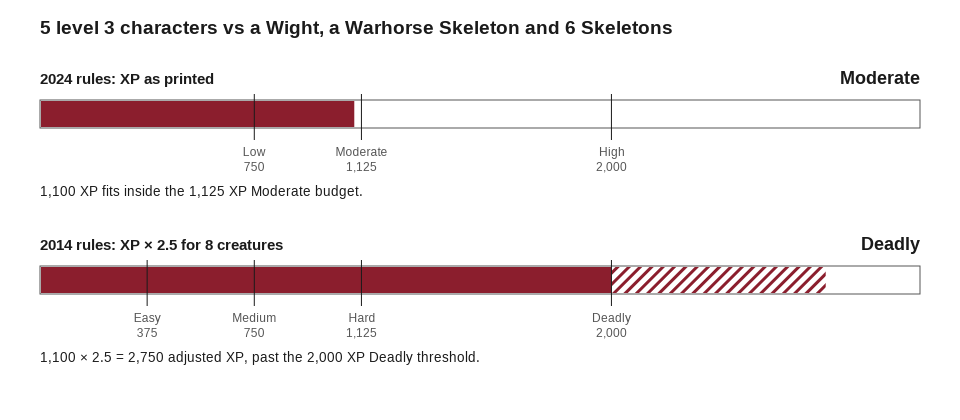
Why does the 2014 mode call my fight Deadly when 2024 calls it Moderate?
Because the 2014 multiplier punishes groups hard. Five level 3 characters against a Wight, a Warhorse Skeleton and six Skeletons is 1,100 XP. Under 2024 that is Moderate, inside a 1,125 XP budget. Under 2014 the eight creatures get a ×2.5 multiplier, so the same fight counts as 2,750 XP and lands in Deadly. The 2014 vs 2024 page walks through it.
How do I build an encounter for a party with mixed levels?
Add each character's budget separately. A party of three level 5 characters and one level 4 character has a Moderate budget of 2,625 XP (750 × 3 + 375). In the calculator, press "Add characters at another level" and enter each group.
Does a monster's lair change its XP?
For some legendary monsters, yes. In the SRD 5.2 stat blocks, monsters like the Adult Red Dragon, the Lich and the Vampire list a second, higher XP value for when you fight them in their lair. Tick "In lair" next to the monster and the calculator uses that number.
How much XP does each character get?
Split the monsters' total XP evenly among the characters who took part. The calculator shows this under the result. In the 2014 mode it uses the real XP, not the multiplied number, because the multiplier only measures difficulty.
Is this an official D&D tool?
No. It is a free fan-made tool. The 2024 rules and monster numbers come from the System Reference Document 5.2, which Wizards of the Coast released under a Creative Commons license.